

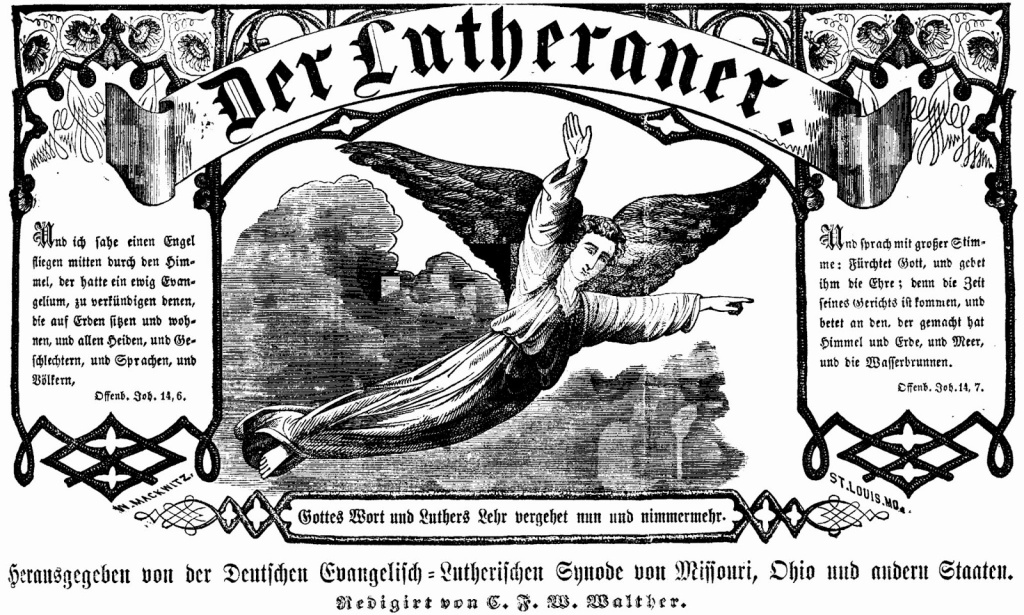
As I have previously shown, the old Missouri Synod condemned those who wished to make teachers of deaconesses. In his brief remarks, Bente referred the reader to the words of the Lutheraner, 73 (1917), p. 8, which I now present, so that the reader may understand more clearly just what was being condemned in the deaconesses.
That the institution of the office of deaconesses in itself contains dangers of evil degeneracy is experienced by people who have this institution. The committee charged with revising the constitution of the Methodist Episcopalians reports concerning this chapter: “The chapter on the deaconess issue has been completely rewritten and frequently changed and expanded. The necessity for this arose from the peculiar way in which the deaconess issue is developing in the English-speaking part of our church. There appears a general inclination to shift the focus of deaconess work — unfortunately at the expense of deaconess nursing — to wider and higher (?) areas of service. All kinds and degrees of teaching, social work, holding society and other meetings, evangelism, thus a kind of auxiliary pastorate, and the like come to the fore.” — There were deacons in the ancient Church. First, the apostles in the first Christian congregation in Jerusalem took care of everything that was to be taken care of. But when the congregation grew larger and more populous, it happened that the Christians from the Gentiles became unwilling, because they thought “that their widows would be overlooked in the daily handouts,” put back behind the widows of the Christians from the Jews. Then the apostles summoned the congregation and submitted to it: “It is not right that we neglect the Word of God and serve at tables. Therefore, dear brothers, look among yourselves for seven men that have a good reputation and are full of the Holy Spirit and wisdom, whom we may appoint to this necessity. But we will continue in prayer and in the office of the Word.” The proposal met with the approval of the congregation, and seven men were chosen for this auxiliary service, among them the famous Stephen, the first Christian martyr. This story is of course told in the sixth chapter of the Acts of the Apostles. These deacons, which in German means servants, as Luther also translated it in his Bible, took care of many kinds of tasks and did some auxiliary leadership, similar to the superintendents among us, so that the apostles had a freer hand to devote themselves completely to their office, the office of the Word. Besides these deacons, there was then also the office of deaconesses, who performed services similar to those of the deacons on the female part of the congregation. One such deaconess was probably also the “sister Phoebe, who is at the service of the congregation in Cenchreae,” as Rom. 16:1 says. The apostle Paul recommends them to the congregation at Rome and asks the congregation “that you receive them in the Lord, as befits the saints, and assist them in all their business in which they have need of you.” And he testifies of her: “For she has also assisted many, including myself.” That both deacons and deaconesses can serve the congregation of God well, if they are people like the apostles describe them: “full of the Holy Spirit and wisdom,” and who know and observe the bounds of their office, is self-evident. The fact that now people have the difficulty that deaconesses do not want to remain within the bounds of their office, but want to arrogate to themselves “all kinds and degrees of teaching” and administer “thus a kind of auxiliary pastorate,” probably has its basis in the fact that it is thought that this, too, belongs to the emancipation, that is, to the freeing of women, that such words as: “Let your women be silent among the congregation” (1 Cor. 14:34) and: “I do not allow a woman to teach” (1 Tim. 2:12) are no longer held as God’s Word, but as the hateful words of a bachelor hostile to women. E. P.
Now how does the modern LCMS compare to the Missouri Synod of Prof. Eduard Pardieck’s time? Well, as I have said before, the LCMS officially considers “teaching” to be one of the primary services of its deaconesses. This is quite different from the old Missouri Synod, which did not recognize this “higher service” of “teaching the Christian faith” as legitimate, but condemned it for ignoring the bounds of the office.


 Altlutheraner