
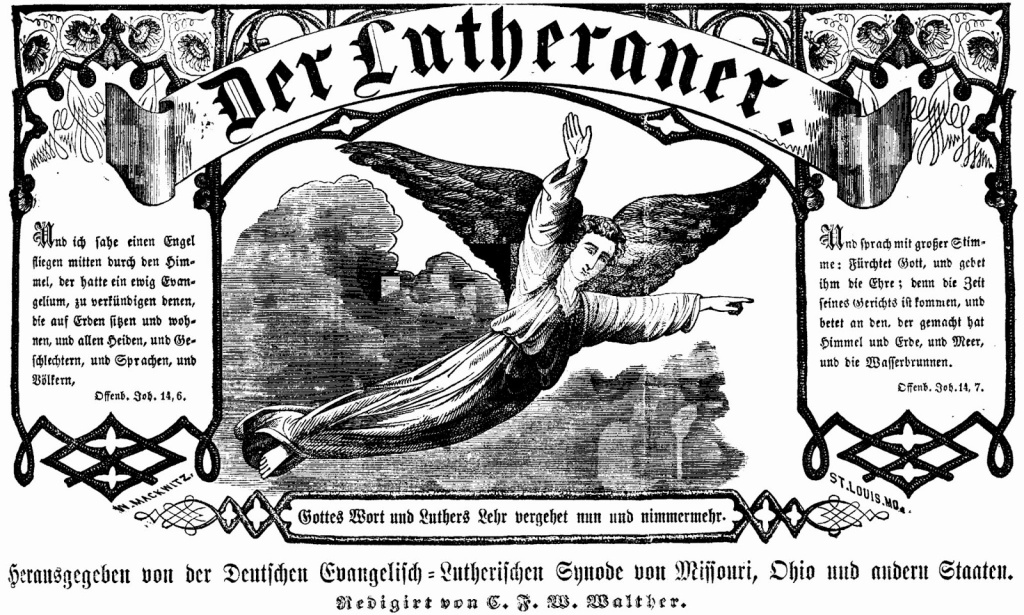
In a review of the tenth volume of the St. Louis Edition of Luther’s works, C. F. W. Walther had this to say, and his words still hold true today:
These writings should be brought into every Lutheran’s home and take first place in every Lutheran home library, next to the Bible and the Catechism. This is all the more necessary, the more the illiterate sons of Luther now try to suspect their faithful teacher, even to accuse him of Calvinism, and to prevent the dissemination of his writings, or only to prepare editions of them for the scholars, in order to give them the opportunity to criticize Luther’s teachings, which they are not at all capable of understanding, given their pride of reason.
Given the stated goal of the American Edition of Luther’s works to avoid translating all of Luther into English, this certainly applies to today’s LCMS. Especially does it apply to men such as Robert Kolb, who judge Luther, based on the calumnies of Melanchthon in his letter to an enemy of the Gospel (see Concordia Journal, October 1997, p. 310, where Kolb refers the reader to Corpus Reformatorum, VI:880), to have been “overheated, overblown, harsh, and petulant.” I am also thinking particularly of the editors of the American Edition, who in volume 61 judge Luther to have unjustly blamed usurers for their rapacious greed, to have defamed the rabbis throughout a book which, owing to his “unexpected attack on the papal church,” they were tempted “to dismiss … as an incoherent rant”; and they judge Against the Roman Papacy to be “scarcely less offensive” than On the Schem Hamphoras. Especially regarding the latter they explicitly state that this book is published only for scholars who absolutely detest Luther and all he taught.
The introduction to volume 61, although it contains significantly fewer criticisms of Luther than the rest of the book, still cannot resist showing its author’s hatred of the Reformer. Thus Benjamin T. G. Mayes asserts that Luther wrote a “neuralgic anti-Jewish text” and repeats the judgment of the late Paul T. McCain: “What was he thinking?”
Also the falsification of Luther’s rendering of Bible passages, noticeably Gen. 4:1, which the “new series” of the LCMS follows, cannot be considered to be anything but a criticism of Luther and the Holy Spirit; for the LCMS now asserts that God did not know what He was doing when He wrote that verse. Fortunately for Him, the wiseacres at The Lutheran Church—Missouri Synod have quite properly corrected His foolish grammar. I am sure He is very thankful.
Finally, the complete rejection of the St. Louis Edition must also be regarded as a rejection of Luther, whom the editors and translators of that edition certainly followed. The only time the St. Louis Edition is mentioned is when it may, by our great scholars, be criticized, although the editors of the Weimar Edition did not make this judgment, but rather praised it, saying:
With the improved reprinting of the old Walch edition, the edition principles of the 16th-18th centuries were reverted to, earlier than the Erlangen and Weimar editions, in order to present a complete edition of Luther’s works that could be understood by all in terms of language and could also be read by non-theologians. In this intention, the St. Louis Edition could certainly claim an independent place next to the Weimar edition published since 1883.
The Christian reader can therefore judge for himself what is to be made of the LCMS.
Some of the “illiterate sons of Luther” would also have to be our neo-Lutherans. These men claim that Luther provided “one of the earliest” justifications for usury. Against this peculiar claim, I will translate Walther’s Thesen über den Wucher. These same men also oppose Luther’s writings on the pastoral office, which base this office, to an extent, on the priesthood of Christians. Proof enough of what tree has spawned this hellish fruit.


 Altlutheraner